

Choosing the right wetting liquids for accurate capillary flow porometry
Accurate pore size measurement by capillary flow porometry depends on more than the porometer itself. While instrument settings and sample preparation are important, the choice of wetting liquid has a direct impact on pore size distribution results, bubble point measurements, and overall data reliability.
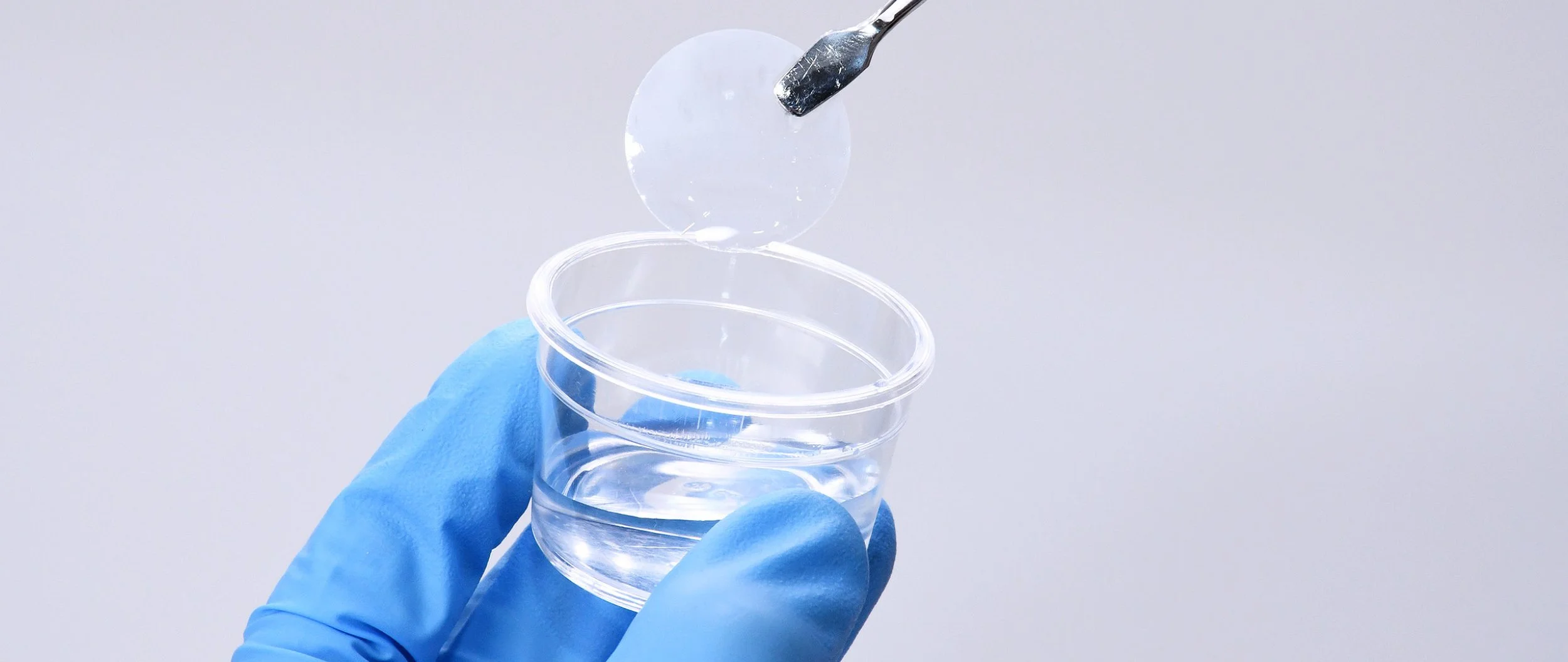
In this article, we explain how wetting liquids influence capillary flow porometry measurements and what to consider when selecting a suitable liquid for your application.
What is a wetting liquid in capillary flow porometry?
A wetting liquid is a liquid used to completely fill the pores of a material before a capillary flow porometry measurement. During testing, gas pressure is applied to displace the liquid from the pores. The pressure required to empty the pores is used to calculate pore size and pore size distribution according to the Young-Laplace equation.
Why the wetting liquid matters
Capillary flow porometry is based on the displacement of a wetting liquid from the pores using gas pressure. The relationship between pressure and pore diameter is described by the Young-Laplace equation, where the surface tension of the liquid and the contact angle are key variables.
For accurate measurements, the wetting liquid should completely wet the material. In other words, the contact angle should be zero. If this is not the case, the calculated pore sizes may be larger than the actual pore size.
Besides complete wetting, other properties also matter. A suitable wetting liquid should:
have a low surface tension
have a low vapor pressure
be chemically inert
not interact with or alter the sample
Not all wetting liquids behave the same
In practice, different wetting liquids can lead to noticeably different results — even when their properties seem similar.
The most commonly used liquids in capillary flow porometry are fluorinated hydrocarbons, such as Porefil and Galpore. These liquids are widely used because they wet most materials, are chemically inert, and have a low surface tension.
At the same time, alternatives such as water, alcohol or silicone oils come with limitations. Water, for example, has a much higher surface tension and can evaporate during measurement, which may lead to inaccurate results. Silicone oils, on the other hand, can be more difficult to remove and may contaminate subsequent tests.
Even between liquids with similar surface tension, differences can occur. As shown in our latest technical note, variations in viscosity can affect the shape of the wet curve and the calculated pore size parameters.
What you’ll find in our new technical note
To bring these insights together, we’ve published a new technical note: “Effect of the wetting liquid on capillary flow porometry results”
In this note, you will find:
a clear explanation of the role of wetting liquid properties
an overview of commonly used wetting liquids and their limitations
practical examples showing how results can differ depending on the liquid
case studies illustrating the impact on curve shape and pore size results
The goal is simple: to give you a practical understanding of how the wetting liquid influences your measurements — and what to consider when selecting one.
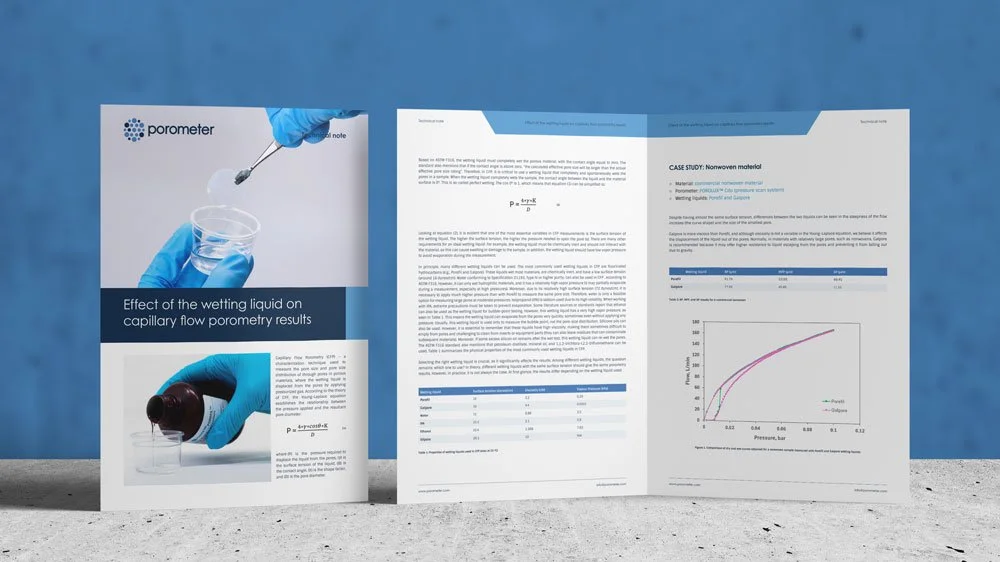
Read our technical note “Effect of the wetting liquid on capillary flow porometry results
“
Request the full technical note and learn how to make the most out of your porometry data.
When a standard approach is not enough
In many cases, a standard wetting liquid provides reliable and consistent results. But some materials require a closer look. This is especially true for new materials, sensitive samples, or applications where consistency and accuracy are critical.
In these cases, our application lab can support you with:
selecting a suitable wetting liquid
comparing alternative liquids
optimizing measurement settings
The goal is to define a method that is not only theoretically correct, but also works reliably in practice for your specific sample.
Explore common pore size characterization applications →
These effects can be clearly visualized using POROLUX™ capillary flow porometers (Cito and Revo), which allow users to compare wet curves, dry curves, bubble point values, and pore size distribution results obtained with different wetting liquids.
Final thought
The wetting liquid is a fundamental part of every capillary flow porometry measurement. Its properties directly influence bubble point determination, pore size calculations, and pore size distribution results.
By understanding how different wetting liquids behave, researchers and quality control professionals can improve measurement accuracy, repeatability, and confidence in their porosity characterization data.
Whether you are measuring membranes, filtration media, battery separators, or porous materials, selecting the appropriate wetting liquid is an essential step toward obtaining reliable capillary flow porometry results.
Questions about your porometry application?
Discuss your material and measurement challenges with our team. We'll help you select the right wetting liquid and optimize your capillary flow porometry results.
FAQ
-
Fluorinated hydrocarbons such as Porefil™ and Galpore™ are among the most widely used wetting liquids because they combine low surface tension, chemical inertness, and excellent wetting behavior.
-
Water can be used in certain applications, but its high surface tension and evaporation characteristics may affect measurement accuracy.
-
Surface tension is a key parameter in the Young-Laplace equation used to calculate pore diameter from pressure measurements.
-
Yes. Differences in surface tension, viscosity, and wetting behavior can affect both the measured pore size distribution and bubble point values.